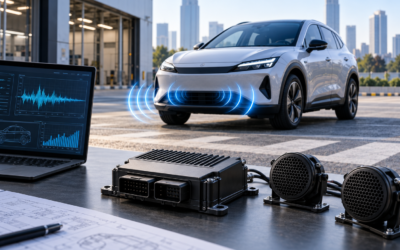
People often search for an EV horn alert sound when they want to understand why a quiet electric vehicle makes a noise while moving slowly, and whether that noise has anything to do with the horn. It does not, and the difference matters for drivers, fleet operators, and vehicle makers.
In this guide, we explain what an EV horn alert sound really means, how a horn differs from an acoustic vehicle alerting system (AVAS), and why every electric vehicle needs both.
What people mean by EV horn alert sound
The phrase EV horn alert sound mixes two different things.
The first is the horn. The driver presses it on purpose to get someone’s attention. It is loud, short, and under the driver’s control.
The second is the alert sound made by an acoustic vehicle alerting system. It plays automatically whenever the vehicle moves at low speed, with no input from the driver at all.
Both are warning sounds, and both protect people on the road. But they do very different jobs, and one cannot stand in for the other.
EV horn alert sound vs AVAS: 4 key differences
1. Who triggers it
A horn works only when the driver decides to press it. An AVAS works without the driver doing anything. It reads the vehicle’s speed and gear, and plays the right sound on its own.
This is the biggest difference. A horn depends on a driver who has already noticed a problem. An AVAS warns people before anyone has noticed one.
2. What it is for
A horn is a message at a moment in time: “I am here, watch out”. An AVAS is a continuous announcement: “a vehicle is moving here”. It gives pedestrians and cyclists a steady sense of where a quiet vehicle is and what it is doing.
3. When it sounds
A horn can be used at any speed, whenever the driver chooses. An AVAS is designed for low speeds, generally up to around 20 km/h, and for reversing. Above that speed, tyre and wind noise usually make the vehicle audible on its own.
4. How it is designed and regulated
A horn is a short, loud, attention-grabbing sound. An AVAS sound is carefully designed. It resembles a vehicle, rises and falls with speed, and has its own reverse sound. Its requirements come from standards: AIS-173 in India and UN R138 internationally. You can read the international text on EUR-Lex.
We explain what makes a good alert sound in our EV alert sound design guide.
Horn, AVAS and reversing buzzer compared
Commercial vehicles often have a third device, the reversing buzzer. Here is how the three differ.
| Horn | AVAS | Reversing buzzer | |
|---|---|---|---|
| Triggered by | The driver | The vehicle, automatically | Reverse gear |
| Main purpose | Get attention at a moment | Announce a quiet vehicle | Warn people behind |
| When it sounds | Any speed, when pressed | Low speeds and reversing | Only when reversing |
| Sound character | Loud and short | Designed, changes with speed | Repeating beep |
| Governing rules | General vehicle rules for horns | AIS-173 and UN R138 | Depends on vehicle type |
The AVAS also plays a sound when the vehicle reverses, as part of its design. Whether a separate buzzer is still fitted depends on the vehicle and the operator.
Can an AVAS replace the horn?
No. An AVAS is not a horn, and a horn is not an AVAS.
A driver may need to call attention to something the AVAS cannot do: a pedestrian stepping out at the last second, another driver not paying attention, a cyclist who has not heard anything. Only a horn lets the driver say “watch out” on demand. So an EV keeps its horn, and it also needs an AVAS. A complete EV horn alert sound setup has both.
The reverse is true as well. A horn cannot do the AVAS’s job. By the time the driver presses it, the pedestrian may already be in danger. And a driver cannot press a horn constantly at 10 km/h in a parking lot.
Common myths about the EV horn alert sound
Myth 1: The AVAS is just an automatic horn. It is not. It is a designed, speed-linked sound with its own standard.
Myth 2: The driver can switch it off if it is annoying. The amended UN R138 does not allow a driver pause switch, as described by Acoustics Today. Always check the latest rules for your market.
Myth 3: A custom horn sound counts as the alert sound. Changing the horn sound does not change the AVAS. They are two separate systems, and the AVAS sound has to meet its own requirements.
Myth 4: An EV horn alert sound is only needed in cities. Low-speed areas exist everywhere: parking lots, depots, lanes and bus stops. The alert is about speed, not location.
How Infiquity AVAS works alongside the horn
Infiquity is a Bengaluru-based engineering company working on embedded systems and automotive electronics. IQ-AVAS | KARNA, our acoustic vehicle alerting system, is engineered to be compliant with AIS-173 and UN R138.
Whatever the EV horn alert sound setup on your vehicle, Infiquity AVAS runs on its own. It takes the vehicle’s speed information, plays a speed-linked alert at low speed, and lets the driver’s horn do its own job. It offers configurable sound profiles and OEM customisation, so a vehicle maker can shape the alert to its platform and brand.
If you are planning an EV or PHEV programme and want to understand how an AVAS fits next to the horn and other warning devices, our team can help. You can also read our AIS-173 compliance deadline guide for the dates and scope of the rules.
Frequently asked questions
What is an EV horn alert sound?
It is a phrase people use for the warning sounds on an electric vehicle. It covers both the driver-operated horn and the automatic alert sound from an acoustic vehicle alerting system.
Is the EV horn the same as the AVAS?
No. The horn is pressed by the driver. The AVAS plays automatically at low speeds and when reversing.
Does an EV still need a horn if it has an AVAS?
Yes. The AVAS does not replace the horn. They do different jobs.
Why does my EV make a sound at low speeds?
That is the AVAS. It plays a sound so that pedestrians and cyclists can hear a vehicle that would otherwise be almost silent.
Can the driver turn the AVAS off?
The amended UN R138 does not allow a pause switch. Check the latest official text for the market you sell in.