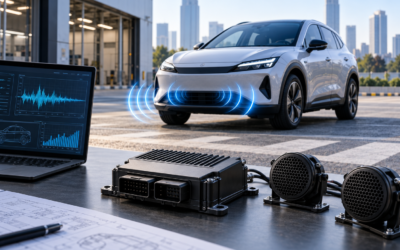
Most conversations about EV alert sound start with cars. But some of the vehicles that worry pedestrians most are much bigger. An electric bus pulling away from a crowded stop. A light truck reversing at a loading bay. A delivery van creeping down a narrow market lane.
A large vehicle moving slowly and silently is a serious risk, and these vehicles are not exempt from the rules. In this guide, we look at why an acoustic vehicle alerting system matters even more for commercial EVs, how their needs differ from a passenger car, and what fleet operators and vehicle makers should check before choosing one.
Why commercial EVs need an acoustic vehicle alerting system
A diesel bus announces itself long before it arrives. An electric bus does not. At low speeds, the motor makes very little noise, and the tyres and wind only add sound once the vehicle speeds up.
Commercial vehicles spend a lot of their working day in exactly the places where that silence is most dangerous:
- Bus stops, where passengers are boarding, alighting and crossing in front of the vehicle
- Loading bays and depots, where workers move around reversing trucks
- Narrow lanes and markets, where people, carts and two-wheelers share the space
- School zones, where children are less likely to judge a vehicle’s speed
These vehicles are also bigger and heavier, and they have larger blind spots. The person who cannot hear the vehicle is also often the person the driver cannot see. A clear EV alert sound gives that person a few extra seconds to react.
What the rule says for buses and trucks
The transport ministry’s notification on AVAS covers electrified vehicles in the M and N categories. Category M includes passenger vehicles, and that means buses as well as cars. Category N covers goods vehicles, from light commercial vehicles up to heavy trucks.
The notification says these vehicles must be fitted with an AVAS meeting the audibility requirements of AIS-173. The dates are 1 October 2026 for new models and 1 October 2027 for existing models.
As reported, two-wheelers and three-wheelers are not covered at present. Rules can change, so always check the latest official notification.
For commercial vehicle makers, the second date matters as much as the first. Existing bus and truck models have until October 2027, but the work involved is larger than it looks, and it is easy to run out of time.
How commercial EVs are different from cars
An acoustic vehicle alerting system built for a small passenger car will not always suit a bus or a truck. Here are the differences that matter most.
- The electrical system. Many commercial vehicles run on a 24V low-voltage system, while most cars use 12V. An AVAS for commercial platforms needs to support the vehicle’s supply voltage. A unit that handles only 12V can rule itself out early.
- Size and speaker placement. On a long vehicle, where the speaker sits changes how well people nearby can hear it. Front and rear placement, mounting height, and exposure to road spray all need thought. This is a planning job for the vehicle programme, not something to sort out at the end.
- A tougher duty cycle. A city bus can run for most of the day, every day. A truck may face heavy vibration, dust, heat, and water splash. The hardware must be validated for those conditions. We cover the kinds of tests involved in our guide to how an AVAS is tested.
- Many variants on one platform. A single chassis may become a passenger bus, a goods carrier or a special-purpose vehicle. The AVAS needs flexible inputs and configurable sound profiles so that one unit can serve many variants, rather than needing a new design for each.
- Reversing. Reversing is a daily activity in depots, loading bays and parking areas. The reverse alert needs to be clear and consistent.
- Fleet operations. Fleet operators care about uptime and serviceability. A unit that is easy to fit, easy to replace and consistent across the whole fleet saves time and money.
What fleet operators and vehicle makers should check
If you are choosing an EV/PHEV audible alert for a commercial programme, this checklist will help.
- Supply voltage: does the unit support the voltage of your vehicle, including 24V?
- Inputs: can it take the signals your vehicle provides, whether CAN, digital or analog?
- Sound profiles: can the sound be configured for different variants and for your brand, while still meeting AIS-173?
- Mounting and protection: is the speaker suitable for outdoor mounting, and does the supplier support placement planning?
- Validation evidence: can the supplier show test reports and the standards they were run against?
- Vehicle approval support: audibility is judged on the vehicle with the AVAS fitted, so does the supplier help with that stage?
Mistakes to avoid
- Treating a bus like a big car. The electrical, mounting and duty-cycle needs are different.
- Choosing a unit that supports only one voltage. This limits you across platforms.
- Leaving speaker placement until late. It affects audibility and may need design changes.
- Forgetting existing models. The 2027 date applies to them, and fleets planning retrofits should start early.
- Assuming a supplier’s test results equal vehicle approval. They support it, but they don’t replace vehicle testing.
Where Infiquity fits
Infiquity is a Bengaluru-based engineering company working on embedded systems and automotive electronics. Our Infiquity AVAS, IQ-AVAS | KARNA, is an acoustic vehicle alerting system engineered to be compliant with AIS-173 and UN R138.
It is built with OEM needs in mind. It supports 12V and 24V systems, accepts CAN, digital and analog inputs, and offers configurable sound profiles and OEM customisation across form, fit and function. That makes IQ-AVAS for EV a practical option across vehicle segments, from passenger cars to commercial EVs.
If you are planning an electric bus, truck or light commercial vehicle programme, we can talk through voltage, inputs, mounting and the evidence you should expect from a supplier.
Frequently asked questions
Do electric buses need an AVAS in India? The notification covers electrified vehicles in the M category, which includes buses, from 1 October 2026 for new models and 1 October 2027 for existing models. Check the latest official text for any changes.
Do electric trucks and light commercial vehicles need one? The N category covers goods vehicles, so they are in scope under the same notification and dates.
Does a 24V system need a special AVAS? It needs a unit that supports 24V. Many commercial vehicles use a 24V low-voltage system, so always confirm the supply range with your supplier.
Can one AVAS serve several vehicle variants? Yes, if it has flexible inputs and configurable sound profiles. This is one of the main things to ask a supplier about.
Is an EV alert sound the same as a horn? No. A horn is pressed by the driver. An AVAS works automatically whenever the vehicle moves at low speed.