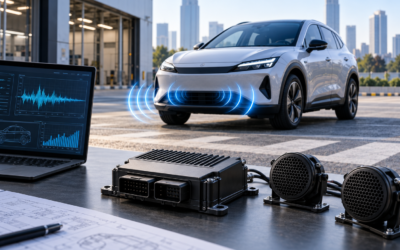
An EV alert sound has one job: to tell a person on the road, within a second or two, that a vehicle is coming. It sounds simple. In practice, a good EV alert sound is the result of careful design, and a bad one can be ignored, misunderstood, or even irritating enough to be switched off.
In this guide, we explain what goes into designing an EV alert sound, the five rules we think matter most, the mistakes to avoid, and how standards like AIS-173 and UN R138 shape the final result.
Why EV alert sound design matters
An electric vehicle is very quiet at low speeds. That is good for city noise, but it takes away the natural warning that a combustion engine gives. The acoustic vehicle alerting system, or AVAS, puts that warning back.
But the warning only works if people understand it. A random beep tells a pedestrian that something is nearby. A well-designed EV alert sound tells them it is a vehicle, roughly where it is, and whether it is speeding up or slowing down. That extra information is what gives people time to react.
This matters most for the people who rely on hearing the most: children, elderly people, cyclists and visually impaired pedestrians.
What makes a good EV alert sound?
A good alert sound does four things at the same time. It is recognised as a vehicle. It carries information about what the vehicle is doing. It is heard clearly in real traffic. And it does not annoy the people living and working beside the road.
Balancing those four goals is what makes the design hard. A louder sound is easier to hear but more irritating. A softer sound is pleasant but may be missed. The best designs sit in the narrow space between the two.
5 design rules for a good EV alert sound
Rule 1: Sound like a vehicle, not an alarm
People learn to react to vehicle sounds from childhood. A tone that resembles a motor or a rolling vehicle is understood immediately. A sharp, repeating beep is more likely to be read as an alarm from a shop or a machine, and people may not connect it with the road.
A recognizable vehicle-like character means the pedestrian does not have to work out what the sound is. They simply know.
Rule 2: Change with speed
A fixed tone says only that a vehicle is present. A sound that rises in pitch and level as the vehicle speeds up, and falls as it slows, says far more. A person can tell if the vehicle is pulling away or coming closer, without even looking.
This is why the standards ask for a sound that changes with speed, and why a speed-linked sound is much more useful than a simple beeper.
Rule 3: Cut through traffic without becoming noise
Traffic noise can hide a quiet sound. This is called masking. To stand out, the sound needs a mix of frequencies, not one single tone.
Lower frequencies carry well and bend around corners and obstacles. Higher frequencies help people work out where the sound is coming from. A design that leans only on high pitches is also a risk, because many older people lose hearing in the high range first.
A balanced mix helps more people hear the vehicle, in more places.
Rule 4: Warn people behind the vehicle
Reversing is one of the riskiest moments for a quiet vehicle. People behind it cannot see the driver and cannot hear the vehicle. A distinct reverse sound gives them a clear signal that the vehicle is about to move backwards.
The reverse sound should be easy to tell apart from the forward sound, so that pedestrians know which way the vehicle is heading.
Rule 5: Be consistent and always on
An alert that works only some of the time cannot be trusted. UN R138 asks for a continuous sound, and the amended version of the regulation does not allow a driver to switch to pause it, as described by Acoustics Today. The reasoning is simple. People should be able to rely on hearing a vehicle every time.
Consistency also applies across units. Every vehicle of the same type should make the same sound, every time, in every condition.
Common mistakes in EV alert sound design
Even careful teams fall into these traps:
- Choosing the loudest sound. More volume does not mean better safety. It means more complaints.
- Using one fixed tone. It gives no information about speed and is easy to tune out.
- Relying on high pitches. They are harsh and may not reach everyone.
- Tuning only in the lab. The vehicle body, speaker position, and enclosure all change how the sound behaves on the road.
- Forgetting the reverse sound. It deserves its own design.
- Treating the sound as an afterthought. Late changes to a sound can mean late changes to hardware.
How standards shape the sound
Standards turn good intentions into measurable requirements. UN Regulation No. 138 sets out how an acoustic vehicle alerting system must behave and how its sound is measured. The full text is available on EUR-Lex. In India, the transport ministry’s notification refers to the audibility requirements of AIS-173. We explain the dates and scope in our AIS-173 compliance deadline guide.
This does not mean every EV has to sound the same. Within the limits of the standard, there is room for a sound with character. Many vehicle makers want a signature sound that fits their brand, as long as it stays recognisable, speed-aware and audible.
Whatever the sound, audibility is judged on the vehicle with the AVAS fitted. Supplier test data supports approval, but does not replace vehicle testing. You can read about the reliability side in our guide on how an AVAS is tested.
How Infiquity approaches the EV alert sound
Infiquity is a Bengaluru-based engineering company working on embedded systems and automotive electronics. Our Infiquity AVAS, IQ-AVAS | KARNA, is an acoustic vehicle alerting system engineered to be compliant with AIS-173 and UN R138.
The IQ-AVAS EV alert sound is built around speed-linked acoustic alerts, with dynamic sound control that adjusts as the vehicle speed changes. It offers configurable sound profiles and OEM customisation, so a vehicle maker can shape the Infiquity EV Alert Sound to suit a vehicle platform and brand, while staying within the standard.
If you are planning an EV or PHEV programme and want to talk through sound design, tuning and integration, our team can help. You can also read our buyer’s guide to EV and PHEV audible alert systems for what to ask any supplier.