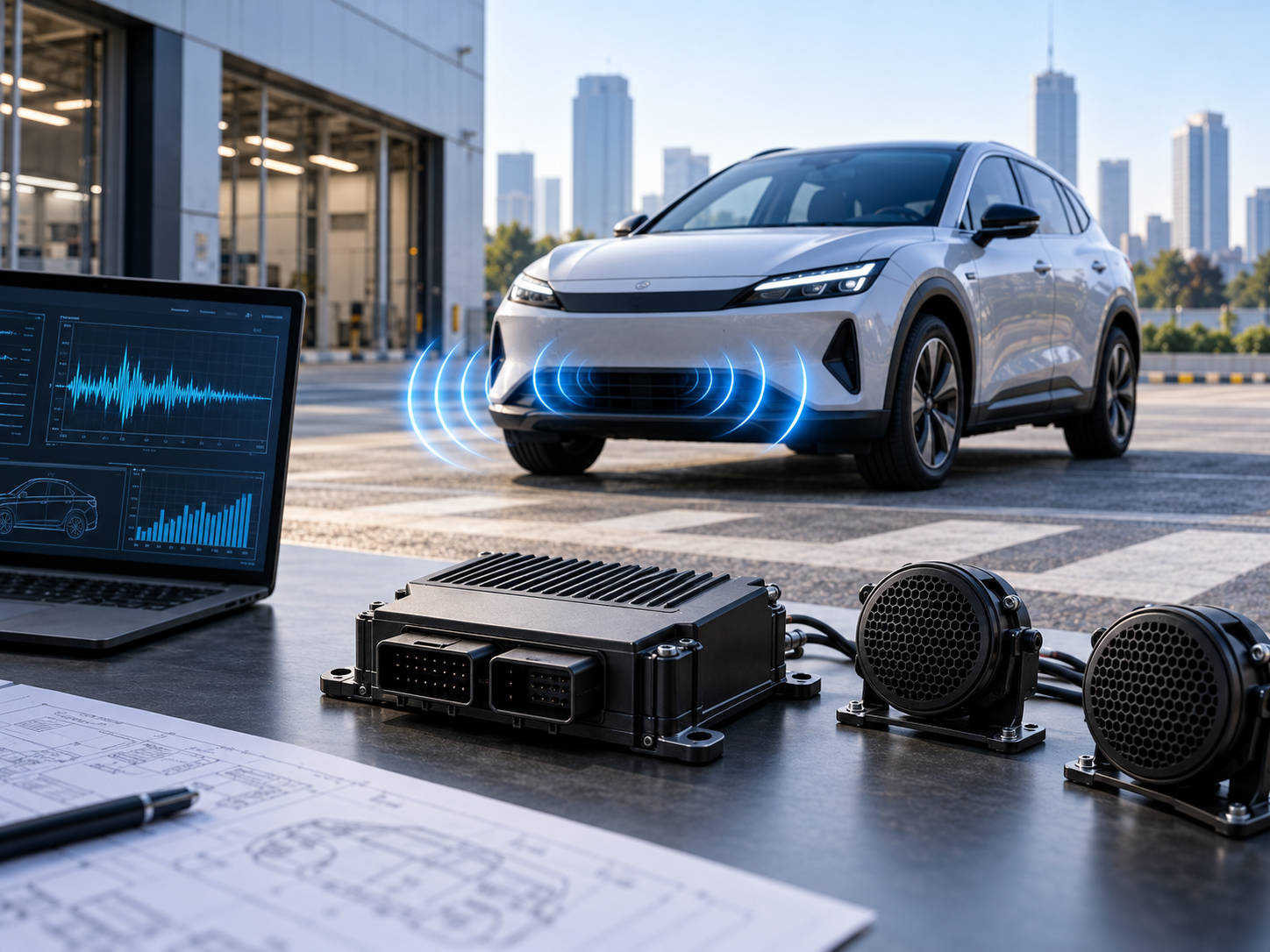
Most people evaluating an acoustic vehicle alerting system start with one question. Does it meet AIS-173? That matters, but it is only the starting point. The real differences between AVAS suppliers show up in the engineering details: how the sound is generated, what inputs the unit accepts, how it holds up under real electrical conditions, and whether it can actually integrate into your existing vehicle architecture without a redesign.
This is a look at what IQ-AVAS actually is, built for anyone comparing options before making a sourcing decision.
What IQ-AVAS is
IQ-AVAS, sold under the KARNA product line by Infiquity Auto Technologies, is an acoustic vehicle alerting system engineered for compliance with AIS-173 and UN R138. It generates a speed-linked audible alert at low vehicle speeds, the range where electric and plug-in hybrid vehicles are otherwise nearly silent to pedestrians and cyclists.
If you’re new to what an AVAS does at a basic level, we’ve covered that separately in our guide to acoustic vehicle alerting systems and EV alert sound.
Core engineering features
IQ-AVAS is built around six features that go beyond meeting the minimum regulatory requirement.
Speed-linked acoustic alerts. Sound output adapts based on vehicle speed, so the alert stays relevant at the low-speed ranges where pedestrian awareness matters most.
Dynamic sound control. The unit automatically adjusts tone and volume based on ambient noise and driving conditions, rather than emitting a fixed, unchanging tone regardless of context.
Multi-input compatibility. Supports CAN 2.0, digital, and analog inputs, which means it can integrate into a range of existing vehicle electrical architectures without forcing a redesign around one specific protocol.
12V and 24V support. Built to work across passenger cars, three-wheelers, buses, and commercial EVs, which typically run different voltage systems.
Customizable sound profiles. OEMs can define a distinct acoustic identity within AIS-173 limits, rather than shipping the same generic tone as every other vehicle on the road.
OEM-grade customization. Form, fit, and function can be adjusted for a specific vehicle platform, covering housing, mounting, speaker placement, and sound logic.
Technical specifications
| Specification | Detail |
|---|---|
| Compliance | Engineered for AIS-173 and UN R138 |
| Operating voltage | 8V to 32V DC |
| CAN protocol support | ISO 11898, SAE J1939 |
| Enclosure rating | IP67 |
| Speaker diaphragm rating | IP65 |
| Acoustic output | Up to 86dB, speed-linked |
| Sound channels | Stereo, two-speaker output |
| Input types | CAN 2.0, digital, analog |
| Platforms supported | Passenger cars, three-wheelers, buses, commercial EVs |
Testing and validation
Specifications on paper only matter if the unit holds up under real testing. IQ-AVAS has passed EMI/EMC testing at GARC, a NABL-accredited and MoRTH-authorized test centre, against AIS 004 Part 3:2009. The tests conducted covered conducted transient immunity, conducted transient emission, radiated emission, bulk current injection, and radiated immunity, all of which passed.
It is worth being precise here. IQ-AVAS is compliant with AIS-173 and UN R138 as an engineering standard, and has passed accredited EMI/EMC testing. A full AIS-173 type approval certification is a separate process that is still in progress. Anyone evaluating suppliers should ask directly what stage of testing and certification a given product is actually at, rather than accepting a general compliance claim at face value.
Frequently asked questions
Is IQ-AVAS AIS-173 certified? IQ-AVAS is engineered and compliant with AIS-173 and UN R138 requirements, and has passed EMI/EMC testing at an accredited facility. Full type approval certification is a separate, ongoing process, and current status should be confirmed directly with Infiquity for the most up-to-date information.
What vehicle types is IQ-AVAS compatible with? Passenger cars, three-wheelers, buses, and commercial EVs, across both 12V and 24V electrical systems.
Can OEMs customize the sound? Yes. Sound profiles can be customized within AIS-173 limits, allowing OEMs to create a distinct acoustic identity rather than using a default tone.
What inputs does IQ-AVAS support? CAN 2.0, digital, and analog inputs, which allow it to integrate into a range of existing vehicle electrical architectures.
Where this fits into a sourcing decision
If you are evaluating AVAS suppliers ahead of the AIS-173 deadline, the technical fit matters as much as the compliance claim. IQ-AVAS is designed to integrate without forcing a redesign of existing vehicle architecture, and is manufactured in India with local engineering support available directly.
For a breakdown of the AIS-173 compliance timeline itself and what OEMs need to do before it hits, see our deadline guide.